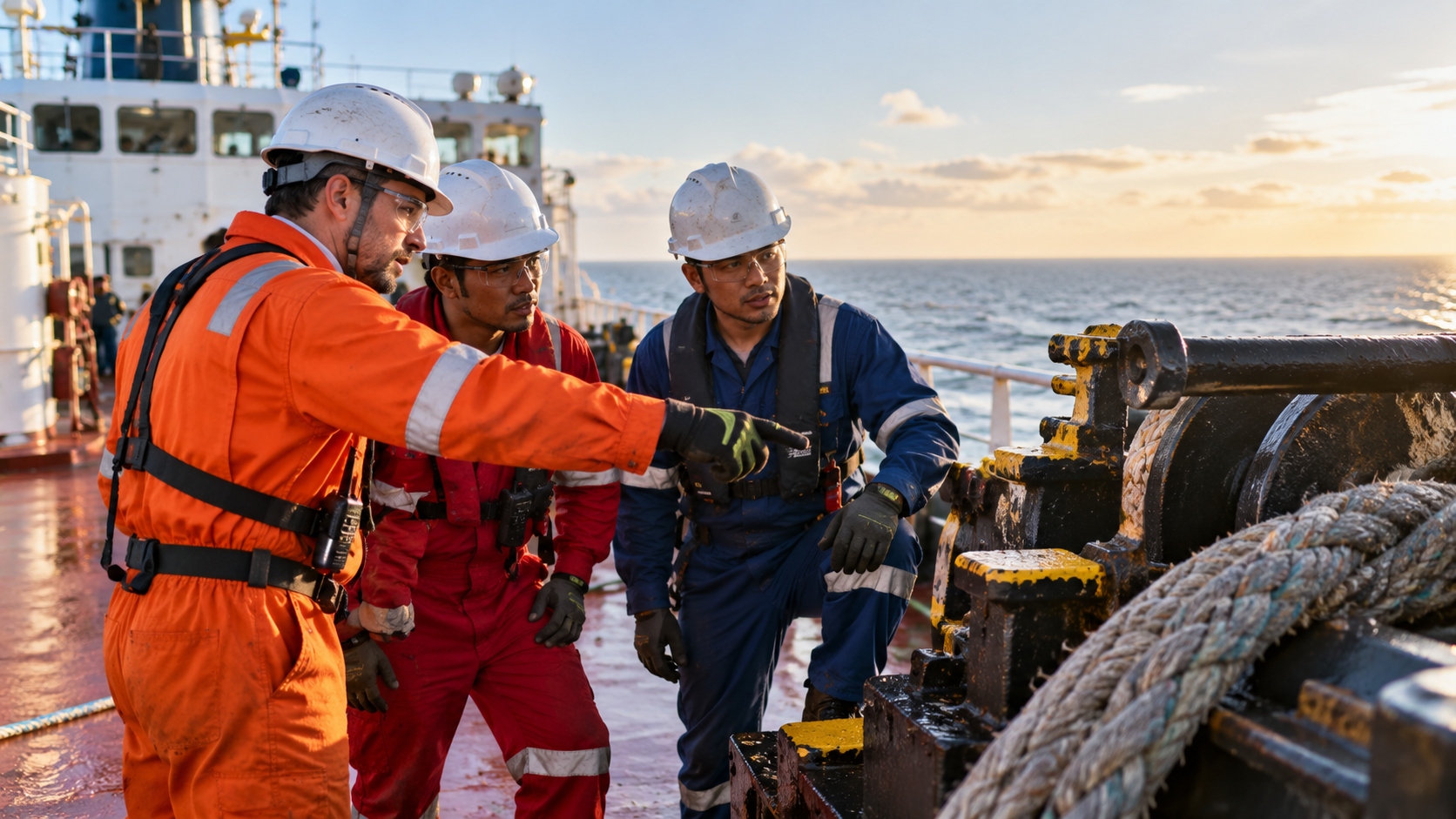
Near Misses That Changed the Way We Work at Sea
Why small warning signs, open reporting and thoughtful corrective actions are essential to a safer ship.
A near miss is useful information
A near miss is an unplanned event that did not result in harm or damage but had the potential to do so.
It offers a valuable opportunity to identify weaknesses before anyone is injured.
The following examples are illustrative scenarios, not reports of actual incidents.
Scenario 1: A tool left above a walkway
During maintenance, a small tool is placed on an elevated grating.
It is spotted before it falls.
The immediate response is to secure the area and remove the hazard.
The deeper lesson concerns tool accountability, worksite housekeeping and checks before an area is returned to normal use.
Scenario 2: A valve almost operated incorrectly
Two adjacent valves are similar in appearance.
An engineer notices a discrepancy between a tag and the planned line-up before operating one.
The event should lead to verification of:
- Equipment identification
- Piping diagrams
- Isolation plans
- Valve labelling
- The effectiveness of peer checks
The lesson should go beyond simply reminding people to be careful.
Scenario 3: A person enters an active lifting area
A crew member starts to cross near a suspended load but is stopped before entering the danger zone.
The response may include improving barriers, communication, lift planning and supervision.
A warning alone will not solve weak control of access.
Reporting without blame
People report more useful information when they trust the process.
That does not mean unsafe acts are ignored.
It means investigating work conditions, communication and controls fairly instead of searching for a convenient individual to blame.
A good near-miss report describes:
- What happened
- What could have happened
- Immediate safeguards
- Contributing factors
- Recommended corrective actions
Photos, timings and conditions can help, provided reporting does not delay making the area safe.
Turning reports into improvements
Effective corrective actions address causes and are checked later.
Updating a risk assessment is useful only when the people performing the task know about the change and can apply it in practice.
Safety meetings should explain what has improved and why.
The practical lesson
A near miss is not a measure of failure.
It is an opportunity to learn before consequences become serious.
The best safety cultures make it straightforward to speak up, act promptly and share what was learned across the vessel.
Comments